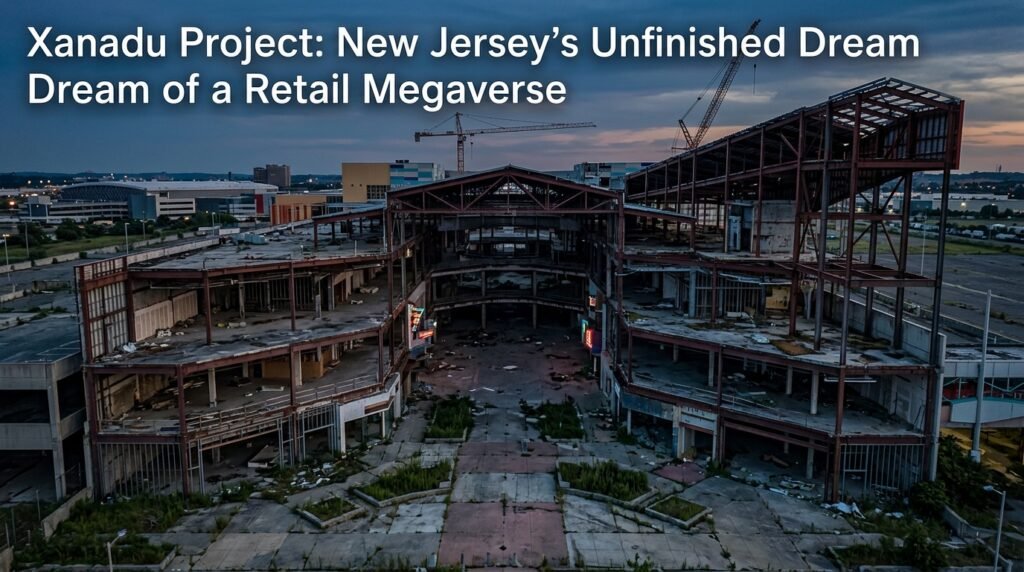
During decades, people on the New Jersey Turnpike, which is close to the Meadowlands sport complex had to drive past a surrealistic construction, a gigantic, multi-colored building, stippled in the abhorrent colours of blue, green, and orange. A half-completed monument among the marshlands. It was a project called Xanadu, which brought up the idea of a Coleridgean dream of a stately pleasure-dome. But whose actuality turned into an emblem of corporate vanity and financial disaster. An unrealized dream of building the ultimate retail megaverse in America. It is a warning of ambition triumphing over reality, which left a physical and economic ghost haunting the landscape of New Jersey.
A Vision Born in the Age of Overkill
Xanadu itself was initiated during the early 2000s, the period of pre-recession hopefulness and the assumption that more immersive and larger-scale retail experiences were the way forward. The vision of the Mills Corporation is simply staggering: to build not a mall, but a 4.8-million-square-foot, 2.3-billion-dollar retail and entertainment complex. This was aimed at being a day -trip destination, a place where shopping was only the minimum activity. The plans included an indoor ski resort using real snow, Ferris wheel, LEGOLAND Discovery Centre, a state-of-the-art movie theater, a skating ring, and a host of theme-oriented restaurants. It was aimed at creating a closed world, a megaverse of consumerism wherein each member of the family would be free to experience their own curated adventure, all with the same, impossibly massive roof.
The Shocking Face of an Imperfect Dream
Since its beginning, the project had problems. Funding was an ongoing nightmare and the construction kept being brought to a halt. The Mills Corporation that was originally failing gave the project under fire to a consortium of lenders. However, it is probably the aesthetics of the early Xanadu project New Jersey stage that was the most notorious. The exterior design that was adopted, a jack of colors and materials that go together very violently, was almost unanimously criticized. Critics and the general public have called it an eyesore, a garish blemish on the Meadowlands. The aesthetic incompatibility became the ideal metaphor of the project itself a malconceived messes of ideas without a binding soul. It was a megaverse that even entered the doors in an identity crisis.
Phoenix Reborn as American Dream
The project, which has experienced stagnancy over the years, was salvaged, with the help of the Triple Five Group, the builders of the Mall of America. They seized the power and restocked the white elephant under American Dream. The rescue mission was an external overhaul of the wild colors, diluting them, and a new effort to deliver on the promise of entertainment. The indoor ski slope (since renamed to Big Snow), the Ferris wheel and the water park gradually became a reality. When American Dream started a gradual opening in 2019, it was presenting much of the original Xanadu spectacle. However, the ground level premise which held that millions would clamor to a mega-entertainment complex based on conventional retailing met with a cruel new reality.
The Curse of Timing and of a Changing World
The timing of the resurrected project was disastrously poor. American Dream, which opened only a few months before the COVID-19 pandemic, had to face lockdowns, social distancing, and terror in crowds right away. The idea of a pop-up and extensive megaverse was now a nightmare in the eyes of the public health. Moreover, the retail industry had changed radically as compared to the time of Xanadu. The emergence of the e-commerce had already undercut the viability of the department stores and the traditional shopping in the malls. As American Dream took a turn to the entertainment sector, which the world could not match through e-commerce and its reliance on high pedestrian traffic, the model was too risky and unsustainable, but it became a permanent nature of consumer behavior.
The Lingering Ghost of Xanadu
The American Dream is in operation today and its financial standing is constantly doubted. It bears the huge burden of debt, and mixed history of its forebear. It will be forever the Xanadu project New Jersey to many a person, a reminder of a dream that was so long in coming. In its tribulations, it demonstrates the frailty of betting billions on old-fashioned grandeur in a digital world. A question in the project was construct the ultimate retail megaverse, will they visit it and will they visit it frequently enough? The solution is, therefore, not clear yet.
The history of the site teaches
An important lesson regarding the vast development. To achieve a successful megaverse, be it a virtual or physical one, a checklist of attractions is not sufficient. It must be executed seamlessly, have a robust financial foundation and popular goodwill and, by far, an absolute timing. These were all lacking in the Xanadu project in its original form. It was reborn as American Dream and carried the token of its history. It is the half-finished dream. However, that is stalked by the specters of its own ambitious, anarchic, scintillating beginnings. It stands lifeless on the Turnpike and that that ideology can break down when faced with an evolving world.