Introduction
Online visibility has become an essential part of business growth. Whether a company operates in e-commerce, technology, healthcare, education, finance, or professional services, reaching the right audience online can make a significant difference. Customers regularly use search engines, websites, digital platforms, and online directories to discover products, compare services, and find reliable businesses. Companies that maintain a strong online presence have more opportunities to attract potential customers, build brand awareness, and increase sales.
SearchSource is a term associated with the origin of searchable information and the systems that help users discover relevant content. Its exact meaning depends on the platform or technical environment in which it is used. In a business context, the concept of SearchSource can help explain how companies organize searchable information, understand where website visitors come from, and improve the way their content is discovered online.
Businesses can apply SearchSource-related concepts to their digital marketing strategies by improving website content, researching relevant keywords, understanding customer search behaviour, and making important information easier to find. When combined with search engine optimization (SEO), content marketing, technical improvements, and performance tracking, these activities can support stronger online visibility.
Understanding SearchSource requires more than knowing its basic definition. Businesses should also understand its uses, important features, practical applications, and limitations. This guide explores how companies can approach SearchSource strategically and use search-related insights to build a more effective digital presence.
1. What Is SearchSource?
SearchSource generally refers to the source of information that a search system uses to find and display relevant results. Depending on the software or platform, it may describe a searchable database, an indexed collection of documents, a website content source, or a technical component that determines where information is retrieved.
For example, an online store may have thousands of products stored in a database. When customers search for a particular product, the website search function checks its available product information and displays matching results. In this situation, the product database acts as a search source.
Similarly, a business website may contain service pages, blog articles, frequently asked questions, and company information. A search system can use this organized content to help visitors locate the information they need.
The term also appears in software development. Certain platforms use SearchSource as a technical name for components that define the information available to a search operation. Therefore, it is important not to assume that SearchSource always refers to one specific search engine, commercial application, or SEO platform.
For businesses, the most useful starting point is understanding how information is collected, organized, indexed, and presented to users. These principles can help organizations improve website navigation, search functionality, content discovery, and digital marketing decisions.
2. Why SearchSource Matters for Modern Businesses
Modern customers expect to find information quickly. When someone searches for a product, service, or solution, they usually compare several available options before making a decision. Businesses that provide clear, relevant, and accessible information have a better opportunity to attract attention.
SearchSource-related concepts are important because they help companies understand the relationship between searchable information and customer discovery.
For example, a customer searching for professional accounting services may visit a search engine, review business websites, compare service descriptions, and read customer feedback. Every useful piece of information can influence the customer’s decision.
Businesses can use search-related insights to identify the information customers are looking for and make their websites more useful.
There are several reasons why this approach matters:
- It helps businesses organize information more effectively.
- It supports better website search functionality.
- It makes important products and services easier to discover.
- It helps marketers understand customer search intent.
- It supports more informed content planning.
- It can improve the overall website experience.
A well-organized digital presence also helps search engines understand the purpose of individual website pages. This can support organic search visibility when combined with relevant content and sound SEO practices.
3. How SearchSource Works
The working process of a search source depends on the system using it. However, most search-based applications follow a similar process involving information collection, indexing, query processing, and result presentation.
Understanding these stages helps businesses identify opportunities to improve their online platforms.
Information Collection
The first stage involves identifying the information that a search system can access. This information may include website pages, product descriptions, customer support articles, documents, or records stored in a database.
For example, an online retailer might organize product names, categories, specifications, prices, and descriptions into searchable records.
Businesses should ensure that important information is accurate, complete, and properly organized before making it available through a search function.
Indexing and Organization
After information is collected, the search system may organize it into an index. An index allows the system to locate relevant information without checking every record individually whenever someone enters a query.
Website search engines also use indexing to understand and store information from publicly accessible web pages.
For businesses, this makes website structure particularly important. Clear URLs, descriptive headings, organized categories, and useful internal links can help visitors and search engines understand the website.
Query Processing
The next stage begins when someone enters a search query. The system examines the words or phrases and identifies information that matches the user’s request.
For example, someone searching for affordable business accounting software expects results related to accounting solutions, pricing, and business requirements.
Companies can improve this experience by using clear product names, relevant descriptions, accurate categories, and helpful website search options.
Displaying Relevant Results
Finally, the system presents matching information according to its available ranking and relevance rules.
The quality of these results depends on the system’s implementation, the information available, and the search logic being used.
Businesses should regularly review their website search results to identify missing information, irrelevant matches, and opportunities to improve navigation.
4. Important SearchSource Features and Capabilities
SearchSource does not have one universal feature set because the term is used in different software and technical environments. However, several capabilities are commonly associated with search-source systems and provide useful examples for businesses.
Searchable Information Sources
One important capability is the ability to identify which collections of information are available for searching.
A business may have separate information sources for products, services, blog articles, help documents, and customer resources.
Keeping these sources organized makes it easier to manage information and provide relevant results.
For example, a technology company can separate its software documentation from its product catalogue. Customers looking for technical assistance can then access relevant support information without sorting through unrelated product pages.
Search Filters
Search filters help narrow results according to selected conditions.
An e-commerce website might allow customers to filter products by price, brand, size, colour, or product category.
A professional services website could organize information by service type, industry, location, or customer requirements.
Filters improve usability because customers can move directly towards the information that matches their needs.
Relevant Search Results
A useful search system should return information that closely matches the user’s query.
Relevance can depend on keywords, product descriptions, categories, metadata, and the search system’s ranking logic.
Businesses should regularly review search results to determine whether important products and resources appear when customers search for relevant terms.
Content Organization
Organized information is easier to manage and retrieve.
Companies can create structured content categories, descriptive headings, consistent naming conventions, and clear website navigation.
These improvements benefit customers while making the website easier to maintain.
Access and Permission Management
Some search systems work with internal company documents, employee resources, or confidential customer information.
In these situations, permission management is essential. Employees should only receive access to information that their roles authorize them to view.
Businesses must also ensure that private information is not accidentally exposed through public search functionality.
Integration With Business Systems
Depending on the implementation, search functionality may connect with content management systems, product databases, customer support platforms, and other business applications.
These integrations can help organizations maintain consistent information across different digital channels.
However, available integrations depend on the specific software being used. Companies should verify technical documentation before assuming that a particular SearchSource implementation supports a feature.
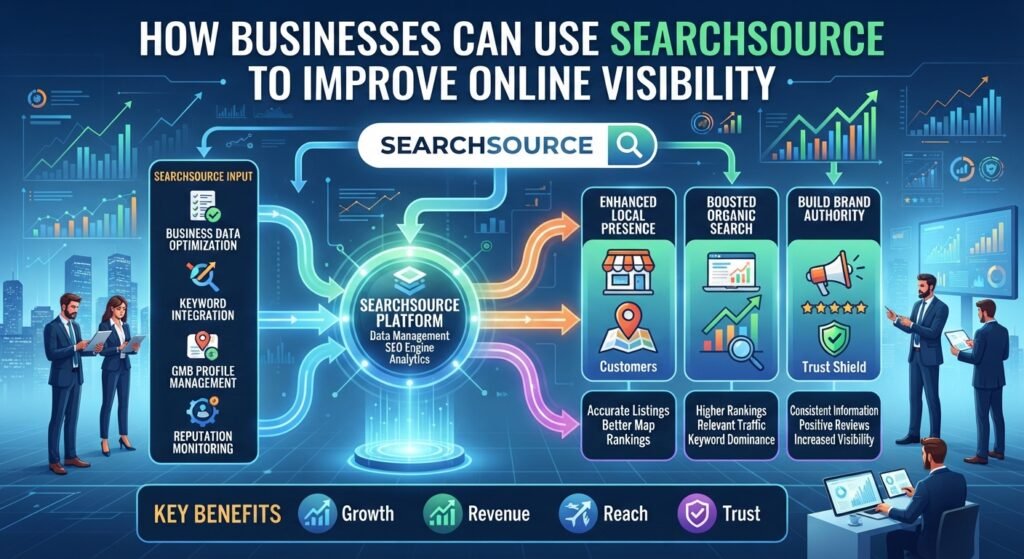
5. How Businesses Can Use SearchSource to Improve Online Visibility
Online visibility depends on several connected activities. Businesses need useful content, a technically accessible website, relevant keywords, strong brand information, and a positive user experience.
SearchSource-related concepts can support these activities by helping companies understand where information comes from and how users discover it.
Improve Website Content Discovery
Businesses should make sure visitors can easily locate important information.
A website with hundreds of pages may become difficult to navigate if its content is poorly organized. Customers might leave without finding the product or service they need.
Companies can organize content into meaningful categories, add internal links, and provide a search function that returns relevant results.
For example, a digital marketing agency can organize its website into SEO services, content marketing, web development, case studies, and educational resources.
This structure makes it easier for potential customers to explore the website.
Understand Customer Search Intent
Search intent describes the reason behind a user’s search.
Some people want general information, while others are comparing products or preparing to make a purchase.
Businesses should understand these differences when creating website content.
For instance, a person searching for “what is website hosting” probably wants an explanation. Someone searching for “business website hosting plans” may be comparing services.
Companies can create different pages for these needs instead of publishing one general article that attempts to answer every question.
Understanding search intent helps businesses attract more relevant visitors and provide information that supports the customer journey.
Identify Relevant Keywords
Keyword research is an important part of search engine optimization.
Businesses should identify the words and phrases their potential customers use when looking for products and services.
A company selling office furniture might target phrases such as:
- Office furniture for small businesses
- Affordable office desks
- Ergonomic office chairs
- Commercial office furniture suppliers
- Modern workplace furniture solutions
These keywords can guide product descriptions, landing pages, blog articles, and other website content.
However, companies should avoid inserting keywords unnaturally. Content should answer real customer questions rather than simply repeating search phrases.
Strengthen Organic Search Visibility
Organic search visibility refers to how easily people can discover a website through unpaid search results.
Businesses can improve their chances of appearing in relevant searches by publishing helpful content, optimizing page titles, improving website structure, and maintaining technical SEO.
SearchSource-related thinking can help companies identify which information should be available and how it should be organized.
For example, a company offering accounting software might create separate pages for invoicing, tax reporting, expense management, and financial reporting.
Each page can address a specific customer need and target relevant search queries.
Improve Local Business Discovery
Local businesses depend heavily on customers searching for nearby services.
Restaurants, repair companies, medical practices, educational institutions, and professional service providers can benefit from accurate business information.
Companies should maintain consistent names, addresses, telephone numbers, opening hours, and service descriptions across relevant online platforms.
They should also maintain an accurate Google Business Profile where eligible.
For example, a plumbing company can publish dedicated service pages describing emergency repairs, pipe installation, water heater maintenance, and service areas.
These pages help potential customers understand what the company offers.
Create Better Landing Pages
Landing pages are designed to encourage visitors to take a particular action.
A business might create a landing page for a specific product, promotional campaign, service, or industry.
Search-related information can help companies identify which questions a landing page should answer.
An effective landing page generally includes a clear headline, useful information, relevant keywords, product or service details, and a noticeable call to action.
Companies should also ensure that landing page content matches the expectations created by the search query or advertisement.
6. SearchSource and Content Marketing
Content marketing is one of the most effective ways to communicate with potential customers and build long-term online visibility.
Businesses can publish blog posts, tutorials, industry guides, product comparisons, research reports, and frequently asked questions to address different customer needs.
SearchSource-related concepts can help marketers organize this information and understand how users discover specific content.
For example, a software company might publish articles about installation instructions, product features, troubleshooting, security, and business applications.
Instead of publishing unrelated articles, the company can create connected content around important topics.
This approach creates a more organized website and helps readers move between related resources.
Publish Educational Articles
Educational content helps customers understand problems and explore possible solutions.
A cybersecurity company, for example, can publish guides about password security, data protection, phishing prevention, and business network management.
These resources can attract visitors who are researching cybersecurity before choosing a provider.
Develop Topic Clusters
A topic cluster is a group of related articles connected through internal links.
A central page covers a broad subject, while supporting articles discuss specific aspects in greater detail.
For example, a digital marketing website could create a central guide about search engine optimization and supporting articles about keyword research, technical SEO, link building, content optimization, and local SEO.
This structure makes related information easier to discover.
Keep Content Updated
Business information can become outdated as products, prices, services, and industry practices change.
Companies should periodically review important pages and update inaccurate information.
Refreshing content also provides an opportunity to improve explanations, add relevant examples, and address new customer questions.
7. Using SearchSource for E-Commerce Businesses
E-commerce businesses manage large amounts of product information. Customers expect to search for products, compare available options, and find accurate details before making a purchase.
An effective search experience can make online shopping more convenient.
Companies can apply search-source principles to improve product discovery in several ways.
First, they should maintain accurate product records. Every product should have a descriptive name, relevant category, detailed description, and useful specifications.
Second, they should provide search filters. Customers may want to narrow results according to price, brand, availability, material, or product features.
Third, businesses should use descriptive product images and provide accurate image descriptions where appropriate.
Fourth, companies should review searches that return no results. These searches can reveal missing product categories, alternative customer terminology, or gaps in the product catalogue.
For example, if customers frequently search for a particular product that is not appearing in the results, the business should examine its product descriptions, category structure, and search configuration.
These improvements can make shopping easier and reduce unnecessary frustration.
8. SearchSource for Digital Marketing and SEO Agencies
Digital marketing agencies work with different industries, clients, and target audiences. They need reliable information to develop effective marketing strategies.
SearchSource-related concepts can support agency workflows by helping teams understand how information is collected and retrieved.
For example, an agency managing several client websites can organize keyword research, content plans, competitor information, and campaign documents into searchable collections.
This organization makes it easier for marketing teams to locate relevant resources.
Agencies can also use search-related insights to identify content opportunities.
If a client operates in the home improvement industry, the agency can research questions related to renovation, flooring, plumbing, painting, and maintenance.
The resulting information can guide content calendars and landing page development.
However, businesses should distinguish between a search source and a complete SEO analytics platform. SearchSource does not automatically provide keyword rankings, competitor analysis, backlink reports, or website traffic statistics in every implementation.
Those activities require appropriate SEO tools and analytics platforms.
9. Technical SEO Practices That Support Search Visibility
A website may contain valuable information but still struggle to attract organic traffic if search engines cannot access or understand its pages.
Technical SEO helps ensure that websites can be discovered, crawled, indexed, and used effectively.
Businesses should pay attention to several important areas.
Mobile-Friendly Website Design
Many people browse websites using smartphones and tablets.
Companies should use responsive website designs that adjust to different screen sizes.
Text should remain readable, navigation should be convenient, and important buttons should be easy to use.
Website Loading Speed
Slow websites can create a frustrating experience.
Businesses should optimize image sizes, reduce unnecessary scripts, use reliable hosting, and review page performance regularly.
Faster loading can improve usability and support a better overall website experience.
Clear Website Structure
A well-organized website should make it easy for visitors to understand where they are and how to find related information.
Companies can use descriptive URLs, logical categories, clear headings, and useful internal links.
XML Sitemaps
An XML sitemap provides search engines with information about important website URLs.
Businesses should maintain an accurate sitemap and submit it through appropriate webmaster tools.
Secure Website Connections
Websites should use HTTPS to protect information exchanged between visitors and the website.
Security is particularly important for businesses that handle customer accounts, payments, contact forms, and personal information.
Structured Data
Structured data helps search engines understand specific information on a webpage.
Depending on the content, businesses may use appropriate structured data for products, organizations, articles, and other supported content types.
Correct implementation can make eligible pages clearer to search engines, although enhanced search appearances are never guaranteed.
10. Practical Guide to Using SearchSource in a Business
Businesses can apply SearchSource-related principles through a structured process.
The following practical guide provides a starting point for companies that want to improve their digital presence.
Step 1: Identify Your Business Objectives
Before making changes, define what the business wants to achieve.
Some companies want more website visitors, while others want additional enquiries, product sales, newsletter subscriptions, or local customers.
Clear objectives help determine which information should be prioritized.
For example, an online clothing store may focus on product discovery and sales, while a consulting company may prioritize service enquiries and professional credibility.
Step 2: Review Existing Website Information
Examine the current website and identify its main content categories.
Check whether important pages contain accurate descriptions, useful headings, clear navigation, and relevant internal links.
Look for outdated information, duplicate content, missing descriptions, and pages that are difficult to access.
Step 3: Research Your Target Audience
Understand the customers the business wants to reach.
Consider their questions, interests, problems, purchasing requirements, and preferred search terms.
Customer feedback, website analytics, search queries, and industry research can provide useful information.
Step 4: Conduct Keyword Research
Use suitable SEO research tools to identify relevant keywords.
Consider search intent, keyword relevance, competition, and the business value of each topic.
Organize keywords into groups according to products, services, locations, and customer questions.
Step 5: Organize Searchable Content
Create a logical structure for important website information.
Separate products, services, blog posts, support articles, and company resources where appropriate.
Use descriptive titles and consistent categories to make information easier to locate.
Step 6: Optimize Website Pages
Improve page titles, headings, descriptions, URLs, and internal links.
Each page should focus on a clear subject and provide meaningful information.
Avoid unnecessary keyword repetition and ensure that content is written primarily for people.
Step 7: Publish Helpful Content
Develop articles and resources that answer genuine customer questions.
Use examples, explanations, practical recommendations, and clear section headings.
Create content that demonstrates the company’s knowledge and helps readers make informed decisions.
Step 8: Improve Website Search Functionality
If the business website includes an internal search feature, test it regularly.
Search for product names, service categories, common questions, and alternative phrases.
Check whether the results are accurate and whether visitors can easily filter information.
Step 9: Measure Performance
Monitor website performance through suitable analytics and webmaster tools.
Review organic clicks, impressions, search queries, conversions, and engagement.
These measurements help businesses understand which activities are producing useful results.
Step 10: Make Continuous Improvements
Digital marketing requires regular attention.
Businesses should review their website, update important content, fix technical problems, and adjust their keyword strategy according to performance.
Consistent improvements can support sustainable online growth.
11. Measuring the Success of SearchSource-Related Activities
Businesses should not judge online visibility only by website rankings.
A successful digital strategy should also consider whether the right people are finding the website and taking meaningful actions.
Several performance indicators can help companies measure progress.
Organic Website Traffic: This measures visitors arriving through unpaid search results. An increase can indicate that more people are discovering the website through search engines.
Search Impressions: Impressions show how often website pages appear in search results. They can help businesses understand whether their search visibility is expanding.
Click-Through Rate: Click-through rate measures the percentage of impressions that generate clicks. Compelling page titles and accurate descriptions can encourage more relevant visitors to click.
Keyword Performance: Monitoring important search terms helps businesses understand how their pages perform for relevant queries.
Conversion Rate: This measures the percentage of visitors who complete a desired action, such as purchasing a product, submitting a form, or requesting a quotation.
Engagement: Engagement indicators can help businesses understand how visitors interact with their content.
Google Search Console can provide useful information about search impressions, clicks, and queries. Google Analytics can help businesses understand website activity and conversions.
Companies should evaluate these indicators together rather than relying on one metric.
12. Common Mistakes Businesses Should Avoid
Although search optimization can provide valuable opportunities, businesses sometimes make mistakes that limit their results.
Keyword Stuffing
Repeating the same keyword excessively makes content difficult to read.
Businesses should use keywords naturally and focus on answering customer questions.
Publishing Low-Quality Content
Publishing large amounts of shallow or repetitive content does not guarantee better visibility.
Each article should provide meaningful information, demonstrate subject knowledge, and offer genuine value.
Ignoring Website Structure
Poor navigation can make important information difficult to discover.
Companies should create logical categories and connect related pages through useful internal links.
Neglecting Mobile Users
A website that works well on desktop computers but performs poorly on smartphones can lose potential customers.
Responsive design should be a priority.
Using Unverified SearchSource Tools
Businesses should not assume that every website or application using the SearchSource name offers the same features.
Before using a specific service, review its official documentation, developer information, privacy policy, pricing, and security requirements.
Expecting Immediate Results
Organic search improvements generally require time.
Businesses should avoid expecting guaranteed rankings or instant traffic growth from a single optimization activity.
A consistent strategy is more useful than constantly changing tactics without evaluating their performance.
13. SearchSource and the Future of Online Search
Online search continues to evolve as businesses and customers adopt new technologies.
Traditional search engines remain important, but people increasingly interact with AI-powered search experiences, voice assistants, website search systems, and specialized discovery platforms.
These developments make well-organized information increasingly valuable.
Businesses should focus on publishing accurate, accessible, and clearly structured content that explains their products and services.
They should also consider how customers phrase questions when using conversational search systems.
For example, instead of searching only for “accounting software,” a customer might ask, “Which accounting software is suitable for a small business with remote employees?”
Companies that publish helpful information addressing these specific questions can create better experiences for potential customers.
SearchSource-related principles can support this process by encouraging businesses to organize searchable information and maintain clear connections between different content sources.
Artificial intelligence may also improve internal search systems by helping users find relevant information through natural language queries.
However, these capabilities depend on the specific technology being implemented. Businesses should evaluate new tools carefully and prioritize accuracy, security, and customer privacy.
14. Best Practices for Long-Term Online Visibility
Building online visibility is an ongoing process rather than a one-time project.
These practices help businesses develop a stronger online presence without relying on shortcuts or unrealistic ranking promises.
Businesses should follow consistent practices that support both search engine discovery and customer satisfaction.
- First, maintain accurate business information across websites and relevant directories.
- Second, publish useful content that addresses real customer needs.
- Third, use descriptive page titles and headings that clearly explain each page’s subject.
- Fourth, maintain a logical website structure with meaningful internal links.
- Fifth, review website performance and address technical problems.
- Sixth, ensure that public content is accessible to search engines while protecting confidential information.
- Seventh, collect customer feedback and use it to improve products, services, and website experiences.
- Finally, evaluate digital marketing performance regularly and adjust the strategy according to measurable results.
15. Frequently Asked Questions About SearchSource
What Does SearchSource Mean?
SearchSource generally refers to the origin or collection of information that a search system uses to retrieve relevant results. Its precise meaning depends on the software, framework, or platform where the term appears.
Is SearchSource a Search Engine?
Not necessarily. SearchSource is not a universally standardized name for one search engine. It may describe a technical component, searchable information source, or other implementation-specific concept.
Can Businesses Use SearchSource for SEO?
Businesses can apply search-source principles to improve content organization, website search functionality, information discovery, and digital marketing workflows. However, SEO activities such as keyword tracking and backlink analysis require suitable tools.
How Can SearchSource Improve Website Visibility?
SearchSource-related concepts can help companies organize searchable information and make important content easier to find. When combined with effective SEO, useful content, and technical improvements, these activities can support better online visibility.
Is SearchSource Suitable for E-Commerce Websites?
Search-source concepts can be useful for e-commerce websites because online stores need organized product information, accurate descriptions, searchable categories, and convenient filtering options.
Does SearchSource Guarantee Higher Google Rankings?
No. SearchSource does not automatically guarantee higher rankings or increased website traffic. Search visibility depends on several factors, including content relevance, technical accessibility, competition, and overall website quality.
What Features Should Businesses Look For in a Search System?
Businesses should consider relevant search results, searchable content sources, filtering options, indexing capabilities, permission management, integration support, and reliable performance.
How Can Small Businesses Get Started?
Small businesses can begin by reviewing their website content, identifying customer search queries, organizing important pages, improving local business information, and monitoring organic search performance.
Is SearchSource a Free Tool?
There is no universal pricing model for SearchSource because the name is used in different technical contexts. Businesses should identify the specific product or implementation before evaluating its cost.
Conclusion
SearchSource provides a useful starting point for understanding how information is organized and retrieved through search systems. Although it does not represent one universally defined SEO platform or standalone search engine, its underlying concepts have practical applications for businesses that want to improve digital information discovery. Companies can apply these principles by organizing website content, improving internal search functionality, researching customer keywords, developing useful articles, and maintaining accurate product and service information. These activities can make websites easier to navigate and help potential customers find relevant information.
Businesses should also combine search-related improvements with established SEO practices, including technical optimization, mobile-friendly design, relevant content, internal linking, and performance monitoring. The most effective approach is to focus on customer needs rather than chasing rankings alone. When businesses provide accurate information, useful resources, and convenient online experiences, they create a stronger foundation for long-term visibility, customer trust, and sustainable digital growth.